

Computer Network Simulations and Early Modern Intellectual Networks
The Case of Margaret Cavendish and the Royal Society


This week’s post shares an exhibit from Women Writers in Context, part of Northeastern University’s Women Writers Project. The authors are Brian Ball and Peter West (faculty members in Philosophy at Northeastern University London), together with two former Philosophy students: Marta Weber and Tyler Gore. Many thanks to Brian and Peter for permission to re-post this, and to Marta and Tyler for their work on the project!
In this exhibit, we outline the findings of computer network simulations research examining the intellectual network around the seventeenth-century philosopher Margaret Cavendish (née Lucas, 1623–1673), with particular emphasis on her connections to the founding members of the Royal Society (henceforth: “RS”). Using computer network simulations, we address counterfactual questions about how the exchange and transfer of knowledge between Cavendish and members of the RS might have been different if her relationship to the RS, and its founding members, were different to how it actually was (e.g., if she had been a member of the RS). We begin this essay by providing some historical context and our motivations for examining this kind of counterfactual question, before outlining our methodology and findings.
In 1667, Cavendish, who was already famous for her prose, plays, and philosophical writing, was invited to attend a meeting of the Royal Society. As noted in a recent blog post on the Royal Society’s website, Cavendish’s attendance at the Society was a significant event, given that she was the first woman to attend one of the Society’s meetings and that women were not admitted as members until 1945. Cavendish was well versed on the scientific developments at what is now Gresham College, in High Holborn, where the Royal Society was based from 1660–1710, through her social connections and her husband, William Cavendish, a high-ranking member of the British aristocracy and the Duke of Newcastle—making Cavendish the Duchess of Newcastle. William and Margaret met in exile on the continent after the English Civil War in the period (between 1649–1660) when England was a Commonwealth (the Cavendishes were staunch Loyalists to the crown).
Further to her poems, plays, and fiction, Cavendish wrote several treatises in natural philosophy. In 1666, she published Observations upon Experimental Philosophy which critiqued the “experimental philosophy” advocated for, and practiced, by members of the Royal Society. In the Observations, Cavendish took a critical stance on the work of experimental philosophers and went as far as referring to telescopes and microscopes as “deluding glasses”. However, her engagement with the Royal Society extended further than her scepticism about the reliability of microscopes. As the diarist (and founding member of the RS), Samuel Pepys explained, Cavendish “had desired to be invited to the Society” and much to her desires Cavendish received an invitation to attend a meeting on the 30th May 1667 at Arundel House (where the Society had been relocated after the Great Fire of London).
Methodology
Our primary source of data concerning the networks and connections between Cavendish and members of the RS was the Six Degrees of Francis Bacon (SDFB) network, a digital network that reconstructs the connections between 13,309 figures in the early modern period. This is an important aspect of our methodology which should also be held in mind when analysing our findings: our own work on the historical connections between Cavendish and the RS can only reveal insights supported by the SDFB dataset.
Further to that, it’s worth saying a little about how the SDFB dataset was compiled. As explained in this scholarly article, the SDFB project drew, in turn, on the Oxford Dictionary of National Biography (ODNB) (Warren et al.). The ONDB contains a large set of entries on various historical figures, written by present-day scholars. This means that if, for example, an entry on Cavendish does not mention or feature a connection to some contemporary figure (say, another natural philosopher) who Cavendish was in fact connected to in some way (e.g., through correspondence), then that would not show up in the SDFB dataset. In turn, that means our own network visualisations and simulations would not account for this fact. It is also worth noting that the SDFB network does not contain all the names/figures contained in the ODNB: the SDFB network contains 13,309 historical figures, while the ODNB contains 58,625 biographical entries on distinct figures. One reason for this is that the ODNB spans a much wider period of time than the SDFB’s period of interest which is restricted to 1500–1700. A second reason is that, in constructing the SDFB dataset, the project leads only included figures who were mentioned at least five times in the ODNB (as they explain in the scholarly article mentioned above). All of this is to say that our own visualisations and simulations are reliant upon the accuracy of the SDFB and the ONDB—but might also be used to inform, augment, or rectify inaccuracies in those datasets too.
SDFB maps out the network of thousands of nodes and several groups of people, including the “Royal Society” and the “Founder members of the Royal Society”. We began our project by exporting the data from SDFB containing the social network of the Royal Society (RS) and Cavendish. Having exported this data, we then used it to generate three distinct (smaller) networks of individuals. One of these networks is historically accurate, i.e., maps onto the way things “really were”—or, more strictly, how things were according to the SDFB dataset. The second and third networks are counterfactual, i.e., do not map on to the way things “really were”, but instead are intended to represent a way that things might have been. The three networks are as follows:
RS without Cavendish: a historically accurate network of the founding members of the Royal Society (as represented through SDFB data).
RS with Cavendish: in this network, Cavendish is added as a “member” of the RS but retains only the connections (or “edges”) that she really has (in the SDFB dataset).
RS with Super Cavendish: in this network, Cavendish is added as a member of the RS and is connected to every other member of the RS, making her the most well-connected member of the RS.
It’s worth saying a little more at how we arrived at networks (2) and (3), which are both counterfactual and do not accurately represent how things were (but are intended to represent how things might have been). RS with Cavendish was generated by adding Cavendish to the RS network and linking her solely to her existing connections. RS with Super Cavendish was generated by connecting Cavendish to every member of the RS, establishing a link with each one. This approach allowed the team to investigate whether Cavendish’s inclusion would improve information flow among RS members.
Briefly, it’s worth introducing some terminology employed in networks research which we will use going forward. First, a “node” is the term for an individual in a network. Each member of the RS is a “node” in the RS network. Cavendish is “node” in networks (2) and (3). Second, an “edge” is the term for the connection between two nodes. So, for example, in RS with Super Cavendish, where she is connected to all the other members of the RS, there exists an “edge” between her and every other “node” in the network.
Now we’ve set out the motivations behind and methodology of this project (and some relevant terminology), the remainder of this exhibit will be divided into three sections. The first will discuss the initial outcomes of applying the Louvain community detection algorithm (a network analysis tool) to our three datasets. Drawing on the work of Beers and Sangiacomo, we explore what it means to be a marginal figure and examine what the implications of being a “marginal” figure are in regard to credence and the pursuit of truth. In the second section, we present the results from running network simulations on each dataset, illustrating the potential impact Margaret Cavendish could have had as a member of the Royal Society. Finally, in the third section, we address the limitations of our methods and interpret our findings thus far. Again, while we cannot really hope to know how the history of science would have been different if Cavendish (or other women) were allowed to be members of scientific communities like the RS, our aim is to offer some insights into how things might have been different. We will also argue that what our network simulations do emphasise is just how important one’s intellectual network is, and how well connected someone is, when it comes to the possibility of influencing or impacting the transfer and exchange of knowledge.
Community Detection
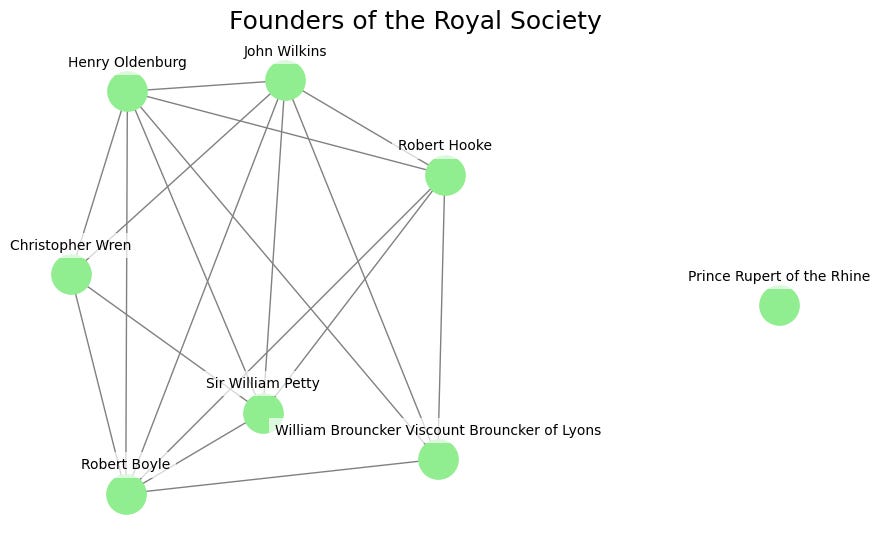
The aim of this section is to provide a clearer sense of what the kind of network we are interested in looks like and, more specifically, to introduce the Louvain community detection method which identifies sub-networks (or smaller groups) within a larger network of historical figures. It is this method that took us beyond the networks contained in the SDFB dataset and enabled us to generate our own networks involving Cavendish and RS. To begin, we can illustrate an example of a network taken from the SDFB. In figure 1 (below), the founding members of the Royal Society are visually represented in relation to one another. To the left are the seven individuals who are connected to one another; this cluster contains both figures with a first-degree relation (e.g., they are directly connected to one another, e.g., by friendship or relation) or figures with a second-degree relation (i.e., they are indirectly connected by a mutual connection). On the right is a single figure. The green circles represent “nodes” and the grey lines represent “edges”. John Wilkins, Henry Oldenburg, and Robert Boyle have the most edges with six each. Prince Rupert of the Rhine, to the right, has no connections. It is a little strange that Prince Rupert is represented as having no shared edges with other members of the RS group, especially given that he was a founding (albeit “honorary”) member of the RS and corresponded with other members of the RS. But this may tell us something about the SDFB dataset, and its construction, or the ODNB itself, rather than the actual historical relationships between Rupert and other founding RS members.
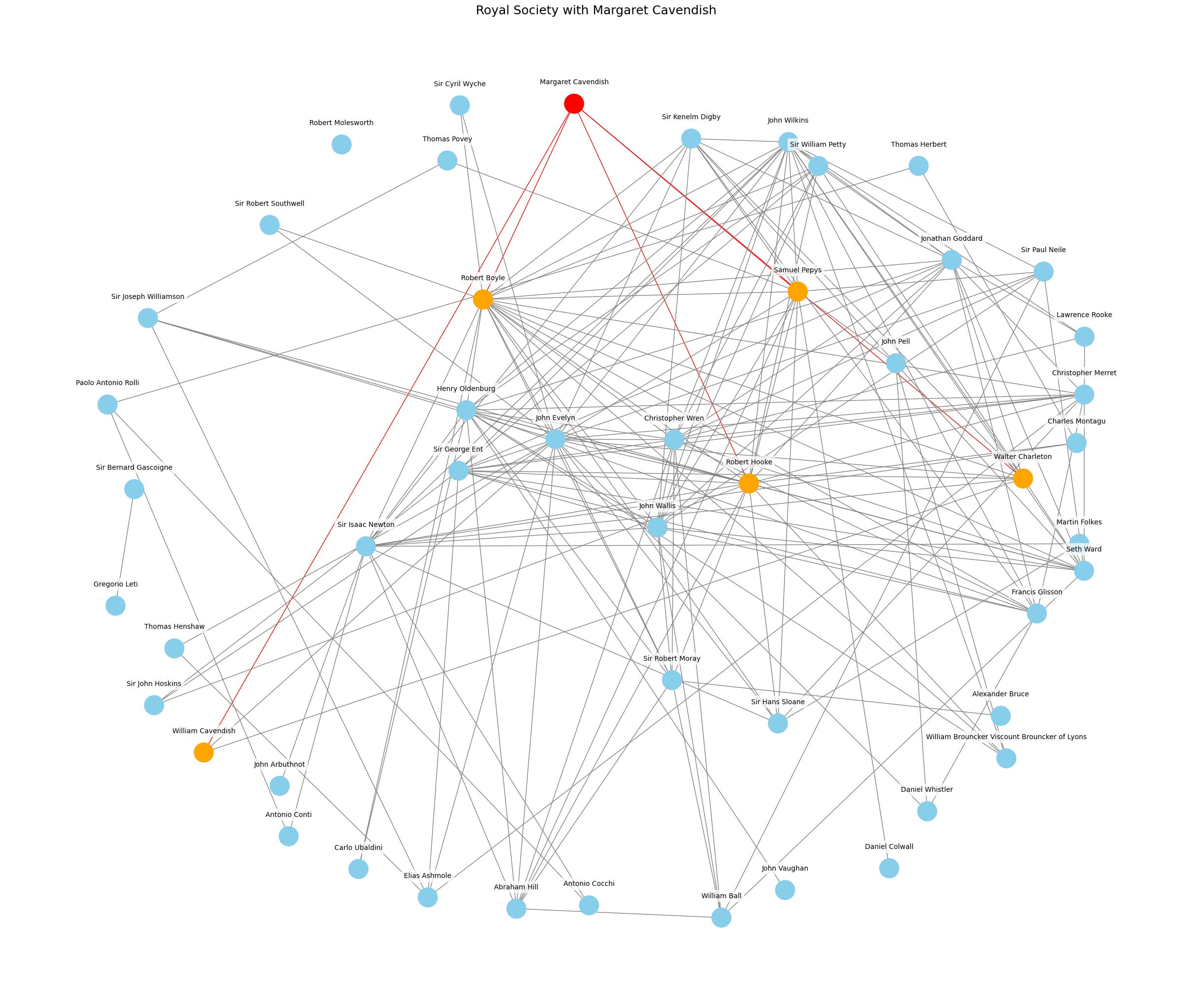
While figure 1 only covers the founding members of the RS, figure 2 (below) is a visualisation of a network containing Cavendish and a much wider range of members of the RS. The founding members of the RS are also represented in this visualisation and Cavendish shares an edge with five of them: William Cavendish, Robert Boyle, Robert Hooke, Samuel Pepys, and Walter Charleton. Boyle and Hooke entertained Cavendish during her visit to the Society. Pepys, as noted, mentions Cavendish at various points in his famous diary, and Walter Charelton exchanged letters with Cavendish about her philosophical work. There are other figures who Cavendish should be connected to (i.e., who she was, in actuality, connected to), such as John Evelyn. However, since they do not appear in an ODNB entry together, there is no statistical inference drawn by the SDFB authors and thus no edge between them. This is a similar case to the one outlined above, where Prince Rupert of the Rhine is represented as having no connections to other founding members of the RS. In both cases, what this reveals is something about the way the SDFB dataset has been constructed—including certain constraints on the construction of that dataset—rather than the reality of the relationships in question (it’s worth noting that this is virtually always the case when we examine real-world relationships through the proxies we can act on computationally).
At this point, it’s worth pausing to reflect on what we might take away from the discrepancies between what we know (through more traditional historical methods) about Cavendish/Rupert and their connections to other figures, and the way those connections are presented in the SDFB dataset. Like virtually all women in early modern writing, Cavendish is what historians would characterise as a “marginalised figure”. She was marginalised, that is, in the sense of having not been taken seriously by her contemporaries or considered important in subsequent histories of the period, due to her identity (as a woman) and, importantly, not because of the quality or originality of her ideas. Many modern scholars have emphasised that she was a sophisticated natural philosopher who defended many innovative and original ideas in her writing. Cavendish’s marginalised status is reflected in the fact that she is not connected in the network to nodes we know she knew through other historical means (e.g., correspondences). In turn, this means some of her relationships remain unrecorded in the ODNB dataset, highlighting her marginalised position. Beers and Sangiacomo refer to marginalised figures from the early modern period as “non-canonical” or “familiar strangers”. They explain that the reason non-canonical figures are not connected in these networks could be the result of a loss or unavailability of resources, e.g., written accounts of her life and work (compared to more “canonical” figures). Further, they explain the fact of being “familiar strangers” is not an accident but correlated with their positions in the network in which they operate.
Below, we’ll explore our findings from running the Louvain community detection function (or “Louvain method”) on the network in figure 2. It’s important to note that we filtered out three nodes from the RS network—Robert Molesworth, Sir Bernard Gascoigne, and Gregorio Leti. This was due to their limited number of edges (either being connected only to one-another or no other nodes) which slowed down the running of simulations (see section three). It would have been “computationally expensive” to include them in simulations; that is, the algorithm would require a significant amount of computing resources, such as memory and, more specifically, processing time to complete its task. Therefore, we decided to remove them from the network. We ran the Louvain method on this filtered dataset.
The Louvain method is an algorithm for identifying communities (or clusters) within large networks by maximising the modularity. Simply, it measures how well a network is partitioned into communities. The operation of the function includes the following key steps: (i) each node is assigned its own community, (ii) for each node, the algorithm considers moving it to the community of each of its neighbours; it will move the node to the community that results in the highest modularity gain (if positive). This step (ii) is repeated iteratively for all nodes until no further modularity improvement is possible. The result of running the Louvain community detection method on the network in figure 2, containing Cavendish and members of the RS, is depicted below in figure 3.
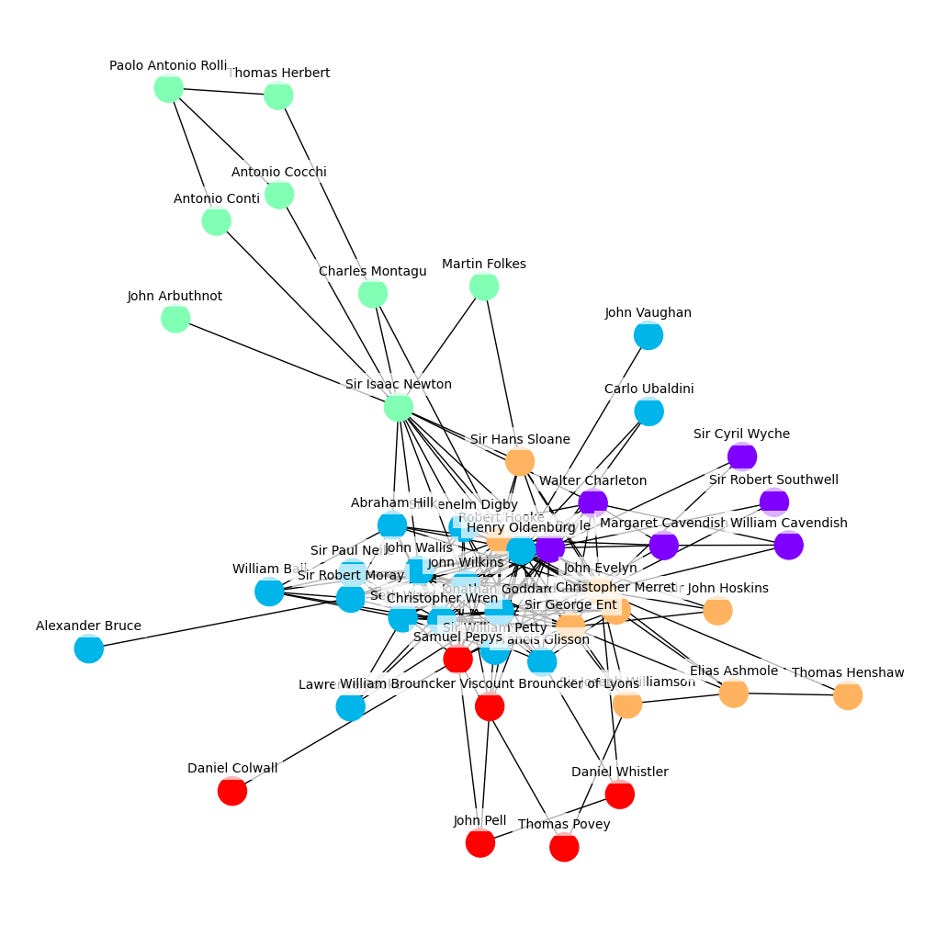
Cavendish is identifiable in the purple community with Robert Boyle, William Cavendish, Sir Robert Southwell, Sir Cyril Wyche, and Walter Charleton—as part of a small sub-network made up of her direct connections (first degree edges). In contrast, figure 4 (below) shows the results of running the Louvain community detection method on a super-connected Cavendish who shares edges with every member of the RS.
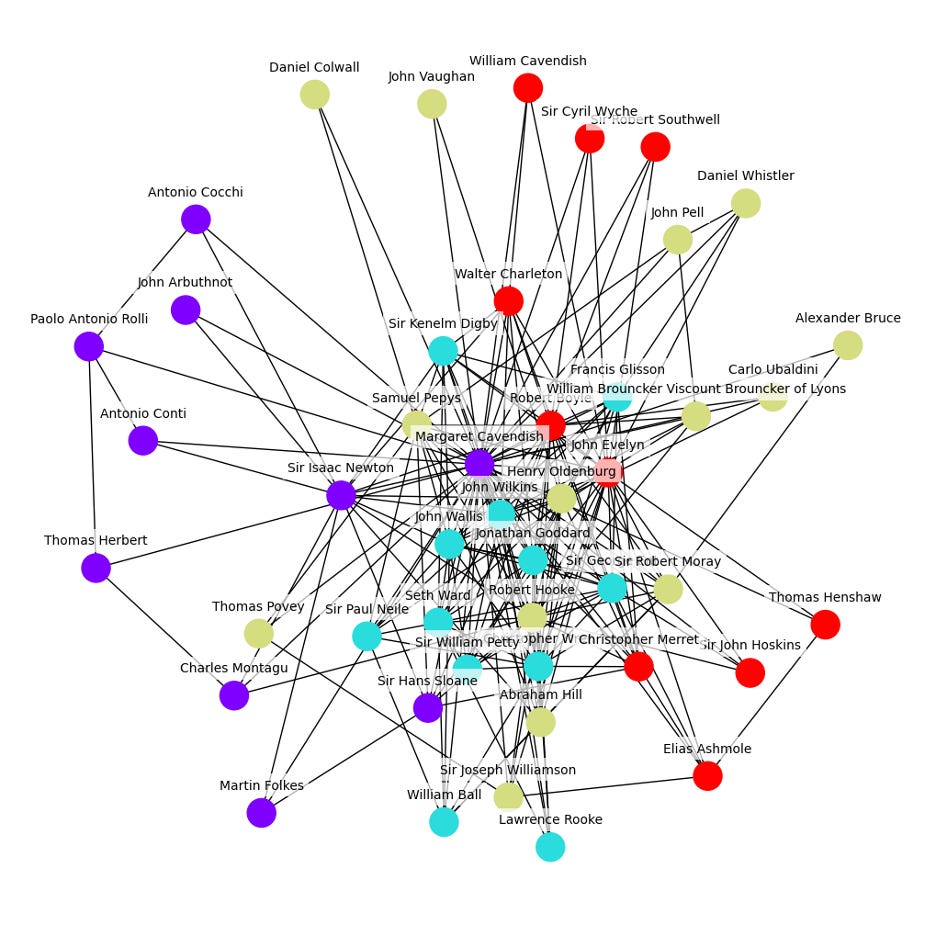
Here, Cavendish is at the centre of a community (or sub-network) that contains Issac Newton’s community from figure 3 (the green nodes in figure 3). This is because the nodes in Newton’s community (e.g., Antonio Conti, Paolo Antonio Rolli, Antonio Cocchi, etc.) are not well connected within the RS network (see figure 2). The Louvain method finds that merging those weakly connected nodes into Cavendish’s more cohesive community yields a higher modularity score. To ensure the stability of our community detection output, we ran the function ten times. Jonathan Goddard remained constant in the same community across each run with Lawrence Rooke, John Wilkins, Seth Ward, and Sir William Petty. A couple of nodes from Jonathan Goodard’s community (as shown in figure 4) appeared in his community for most runs and only changed once or twice (Francis Glisson, Sir Kenelm Digby, William Ball, Sir Paul Neile, John Wallis, Sir Christopher Wren, and Sir George Ent).
Cavendish’s community allocation remained constant across all ten runs. Her community is blended with Issac Newton’s community from figure 3. There were certain nodes which joined Cavendish’s community for particular runs and overall, across all ten runs, there are fewer communities produced when Cavendish is connected to all nodes in the RS network. There were on average four or less communities in the RS with Super Cavendish network after the Louvain method had been run. Whereas in our other two datasets (the RS without Cavendish and RS with Cavendish), there were five communities detected by the Louvain method on average. The reason Issac Newton has his own community in the RS network (figure 3) is because he has the highest betweenness centrality—a measure of how often a node lies on the shortest path between other nodes. The output from the Louvain method when run on the network, with Cavendish connected to the RS, demonstrates that when her centrality is improved, the modularity is also improved.
In the next section, we address how Cavendish’s connectedness impacts her ability to influence the transfer and exchange of knowledge. We hypothesised that when Cavendish is not a familiar stranger to the Royal Society but a well-connected, central member (i.e., the situation depicted in RS with Super Cavendish), she would positively impact the transfer and exchange of knowledge, by virtue of being well-connected. We explore our simulation results in the next section.
Simulating the Transfer and Exchange of Knowledge
A core component of this project involved simulating the transfer and exchange of knowledge within the RS network. Employing the methodologies developed by NU London’s PolyGraphs project, we modelled the transmission of information and the resulting shifts in member beliefs within these networks. Each node in the simulation was initially assigned a random belief certainty, ranging from 0 to 1, leaning slightly towards B (truth) as opposed to A (falsity). It’s worth explicitly noting that this setup assumes the existence of an objective (“scientific”) truth. The simulation then proceeds on the basis that nodes in the network then generated evidence and exchanged information, subsequently adjusting their beliefs. The simulations ended when all members of the network reached a consensus on a single opinion, typically aligning with the truth.
To get a little clearer on what all this means, we can imagine a group of scientists with varying degrees of certainty about a specific scientific hypothesis—for instance, the claim that Saturn has 274 moons. Our simulations explore how the beliefs of the members of the group might evolve through conversations, which are made possible by their connections to one another. We can think of the network simulations method as being about tracking how long it takes for the entire group to reach a consensus on (e.g.,) the truth or falsity of the claim that Saturn has 274 moons.
Returning to our own simulations on networks involving the RS, from the SDFB network, we extracted two groups of people. (1) The Royal Society, and (2) Founders of the Royal Society. Using this data, we ran two experiments. First, we added Cavendish to each group while maintaining her real-life connections, or edges (as in RS with Cavendish). In the second experiment, Cavendish was connected to each node in each respective group (as in RS with Super Cavendish). We wanted to explore Cavendish’s position in comparison with other members of the RS, as well as the impact she had or could have had on the RS. In all instances, the simulations were repeated at least fifty times.
One parameter tracked during the simulations, are the nodes’ average beliefs over time. Below are the plots of the nodes’ average beliefs in the founders network, with Margaret Cavendish added. What these visualisations show is the average degree of belief in the truth from each member of the group (measured on the vertical axis) across iterations of the simulation (measured on the horizontal axis). The visualisations below track average belief in the truth in the RS with Cavendish and RS with Super Cavendish networks.
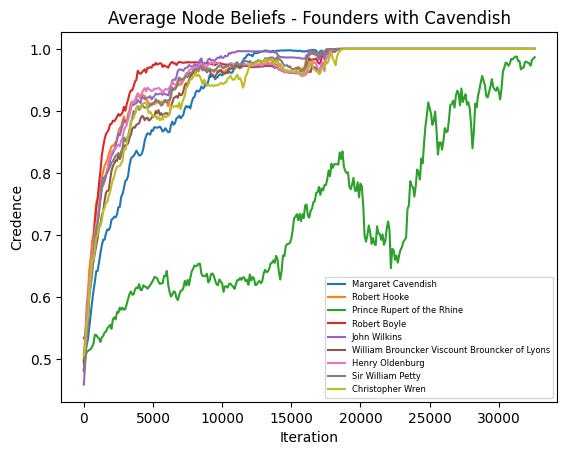
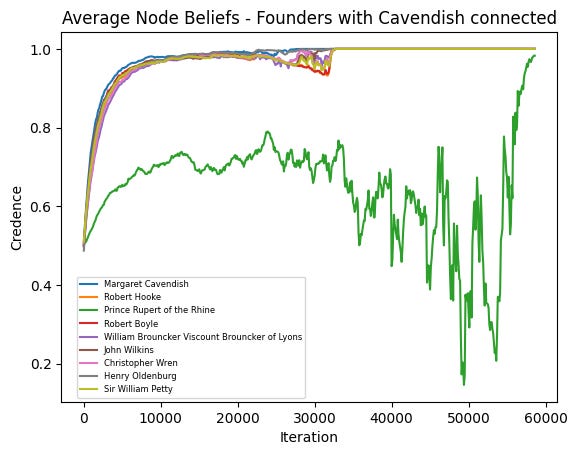
These network simulations involve elements of randomness, both in the initial beliefs that are assigned to the agents (averaging at roughly 0.5 across the various sims) and in the stochastic (or chancy) manner in which evidence is generated to be observed and communicated (thereby affecting the evolution of beliefs as the simulations progress).
Strikingly, in both cases, Prince Rupert of the Rhine represents the lowest average belief at every iteration, also making him the last to reach the truth. As we noted earlier, Prince Rupert is something of an outsider or is at least represented as one in the original SDFB dataset. It seems plausible that the fact that he’s poorly connected to the rest of the group might explain the fact that he is consistently last to reach the truth. Drawing on our previous example, imagine a hermit who never speaks to anyone else about astronomy, it seems plausible that they would be the last to ever come around to knowing that Saturn has 274 moons. Rupert, it seems, is in a comparable position.
In contrast, Cavendish, even though her belief is very similar to the average belief of the other nodes, receives the second lowest score and is the second slowest to converge to the truth (only Prince Rupert is slower) when she maintains her actual connections (in figure 5). This is likely to be reflective of her marginalised status; the real Margaret Cavendish was not able to form as many connections as her (male) contemporaries. When we extend a RS membership to her for our experiment, we find she faces challenges in discovering the truth. This situation resembles Prince Rupert’s, who holds membership yet is poorly connected to other members (in the dataset we were working with), leaving him at a disadvantage. However, when Cavendish is connected to all nodes in the network, and becomes Super Cavendish (in figure 6), she holds the highest average belief and is the first one to reach the truth. The point, it seems, is that the better connected you are, the more likely you are to learn from other members of the group and, in turn, reach the truth.
Another important measure that we employed was the overall number of steps that it takes for the entire network to reach the truth (i.e., for the simulation to end). This is demonstrated with a box plot below, for the RS network.
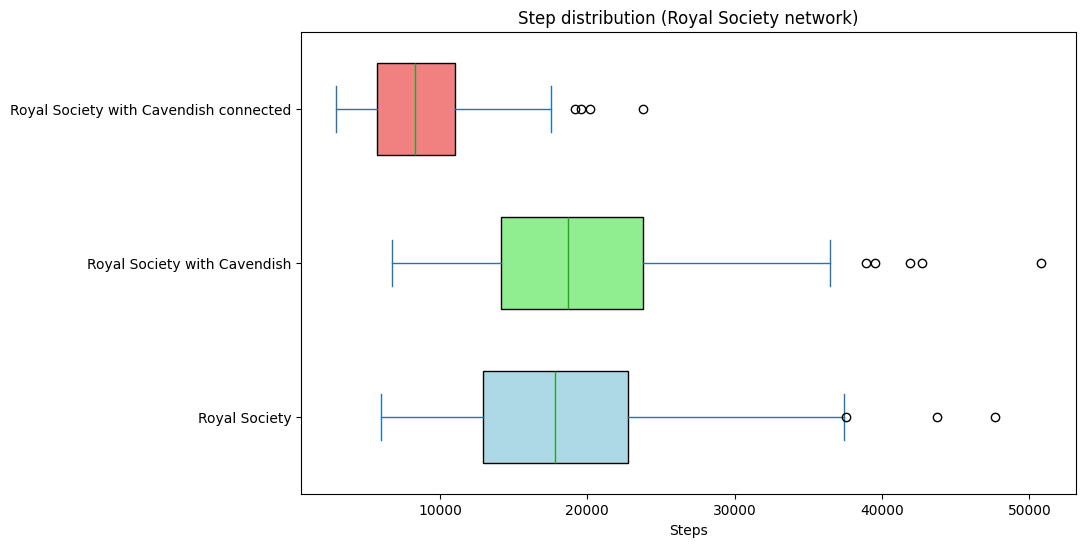
As shown above, when Cavendish is added to the Royal Society, the average number of steps needed to reach the truth increases slightly (but not significantly). However, when she is connected to all members, the mean, as well as the minimum and maximum values decrease considerably (and significantly). The number of outliers remains more or less the same in all three cases. While the results are noteworthy, it’s crucial to acknowledge the simulation tool’s constraints before drawing conclusions.
Reflections on Our Method and Findings
Our use of simulation tools for social networks is inherently speculative. We operate within the realm of “what might have been”, rather than “what would have been” (if Cavendish’s relationship to the founder members of the Royal Society had been different), to use a distinction from David Lewis (1973). In the case of Margaret Cavendish’s potential membership in the Royal Society, these simulations help us explore possible alternative or counterfactual scenarios. This exploration is driven by two factors: first, the deliberate addition of Cavendish to existing networks and subsequent connections with all members, and second, the inherent randomness present in network simulations. Therefore, these exercises focus on hypothetical possibilities. It is undetermined, had Cavendish been a member of the RS, which members she would have actually been connected to, as well as how exactly information would have been transmitted within the network. In other words, it remains unclear just how close the simulation results are to the actual world.
Further, network simulations assume a certain number of idealisations. For instance, the PolyGraphs project tool assumes that people are rational, and therefore form beliefs rationally, from exchanging information and collecting evidence. The PolyGraphs project does note this limitation by suggesting that people are not always rational and do not always form their beliefs rationally (see Ball et al. 2024). The SDFB network has inherent limitations. It is not an exhaustive record of early modern interactions, primarily due to constraints in the ODNB and statistical inference. Consequently, our findings will reflect this incompleteness. One example of this is the absence of Cavendish’s link to John Evelyn, as mentioned earlier. Further, certain abstractions are in place. Notably, personal beliefs, biases and personalities are not accounted for in the network. Margaret Cavendish’s real-life connections to William Cavendish, Thomas Hobbes, and Walter Charleton—through marriage, mutual acquaintances, and correspondence—are captured in the network data of the simulation. It also correctly shows her absence from the RS. However, the simulation cannot represent many personal aspects of her life, such as her imagination, biases, and personality. Therefore, the simulation illustrates the potential impact of an individual structurally connected in the same manner as Cavendish, rather than the actual influence of Margaret Cavendish as a complete person on the advancement of 17th-century scientific knowledge: a node in a network, rather than a real human being.
The results should then not be interpreted as evidence of what would have happened had Cavendish (or other women) been admitted to the 17th-century Royal Society, but rather as a sample of what could have taken place. While what exactly would have happened remains unanswered, the project’s results give us some insight into the counterfactual sphere. That insight is of most value when considered in combination with existing theories of marginalised figures and feminist literature. For instance, the perceived absence of women’s contributions to institutions like the RS, which resulted in their exclusion, was actually a consequence of that very exclusion, rather than a reflection of any genuine lack of capability. Jessica Gordon-Roth and Nancy Kendrick raise a similar point. In their paper, they argue that early modern women philosophers’ texts are often treated in ways that are different from, or inconsistent with, the explicit commitments of the analytic tradition (Gordon-Roth and Kendrick). In doing so, perhaps unintentionally, we risk encouraging audiences to dismiss these women as philosophers and their texts as philosophical, even when our aim is to affirm their philosophical significance.
Cavendish’s slow arrival at the truth, when she is added to the Founders network, seems to reflect her small number of connections. It should not be taken to reflect anything about Margaret Cavendish herself and her likelihood or ability to reach the truth. And when she is more connected (to all founding members), her score dramatically increases. This is true also for Prince Rupert of the Rhine. Thus, a low number of connections has a detrimental impact on reaching the truth. The results, therefore, seem to reflect that having fewer connections, as women in the 17th century did, makes the process of arriving at certain truths (e.g., scientific truths) slower. As the results suggest, this holds true for Cavendish, despite her having been extraordinarily well connected for a woman of her time.
Connecting marginalised individuals, such as Cavendish, to the RS ultimately benefits the entire network. Though initially, including such figures may seem to delay reaching the truth, the broader connectivity fostered significantly speeds up the overall distribution of information and the truth. This finding is significant because it supports the claim, made by recent scholars (e.g., Sikimić 2023 and Fehr 2011), that when science and knowledge production is more diverse, i.e., when we hear from people with a range of voices, there is an epistemic benefit. In other words, it is better for science if the scientific community is more diverse (it is worth noting that this kind of claim has been made recently by figures such as Athene Donald in her Not Just for the Boys: Why We Need More Women in Science). Our findings, then, are not only historical but support claims about science and knowledge production more generally.
Based on these promising initial findings, the research team at NU London aims to delve deeper into computational methods. This will allow for a more thorough understanding of how early modern writers could have contributed to the development of both philosophy and science and their historical significance in these fields.
Sources
Ball, Brian, Alexandros Koliousis, Amil Mohanan, & Mike Peacey. “Misinformation and Higher-Order Evidence.” Humanities and Social Sciences Communications 11, 2024, https://www.nature.com/articles/s41599-024-03806-8.
Beers, Dan and Andreas Sangiacomo. “Divide et Impera: Modeling the Relationship between Canonical and Noncanonical Authors in the Early Modern Natural Philosophy Network.” HOPOS: The Journal for the International Society for the History of Science 10 (2), 365–413, https://pure.rug.nl/ws/portalfiles/portal/149811284/710178.pdf.
Donald, Athene. Not Just for the Boys: Why We Need More Women in Science. Oxford University Press, 2023, https://global.oup.com/academic/product/not-just-for-the-boys-9780192893406.
Fehr, Carla. “What Is in It for Me? The Benefits of Diversity in Scientific Communities.” In Feminist Epistemology and Philosophy of Science, edited by Heidi E. Grasswick, Springer, 2011, https://classes.matthewjbrown.net/wp-content/uploads/sites/9/2015/01/fehr-benefits.pdf.
Gordon-Roth, Jessica and Nancy Kendrick. “Recovering Early Modern Women Writers: Some Tensions.” Metaphilosophy, 50: 3, 2019, 268–285, https://onlinelibrary.wiley.com/doi/abs/10.1111/meta.12357.
Lewis, David. Counterfactuals. Blackwell, 1973.
Moore, Shawn. “Networks as Constructs: The Curious Case of Margaret Cavendish, Duchess of Newcastle”. Digital Cavendish: A Scholarly Collaboration, 2013, http://digitalcavendish.org/2013/06/22/networks-as-constructs/.
Sikimić, Vanja. “Epistemic Inclusion as the Key to Benefiting from Cognitive Diversity in Science.” Social Epistemology 37: 6, 753–765, https://pure.tue.nl/ws/portalfiles/portal/313033165/Epistemic_Inclusion_as_the_Key_to_Benefiting_from_Cognitive_Diversity_in_Science.pdf.
Warren, Christopher, et al. “Six Degrees of Francis Bacon: A Statistical Method for Reconstructing Large Historical Social Networks.” Digital Humanities Quarterly 10: 3, 2016, https://dhq-static.digitalhumanities.org/pdf/000244.pdf.